Choosing a Main Circuit Breaker is not a matter of picking the largest number that fits. The correct choice depends on the electrical system, the panel’s specifications, and the building’s calculated load. A breaker that is too small may trip repeatedly; one that is oversized may fail to provide appropriate protection. Small details matter.
Start by checking the panel label and the existing breaker’s ratings. Note the manufacturer, model, voltage, amperage, number of poles, and interrupting rating. These details help establish compatibility, but they do not confirm that a replacement is safe. A panel can look spacious while having strict limits on approved breaker types. Its label is more useful than appearance.
Load calculations also matter. Major appliances, heating equipment, and future additions can change the demand on a service. A simple count of outlets is not enough. This is where assumptions can go wrong; even a familiar home may have an unusual load pattern. Local electrical requirements and utility conditions may also affect the selection.
This guide explains how to compare breaker ratings, verify panel compatibility, and recognize when professional assessment is needed. If the panel information is missing, damaged, or unclear, do not guess. A licensed electrician can inspect the equipment, calculate demand, and confirm the correct option. That extra check is practical, not excessive.
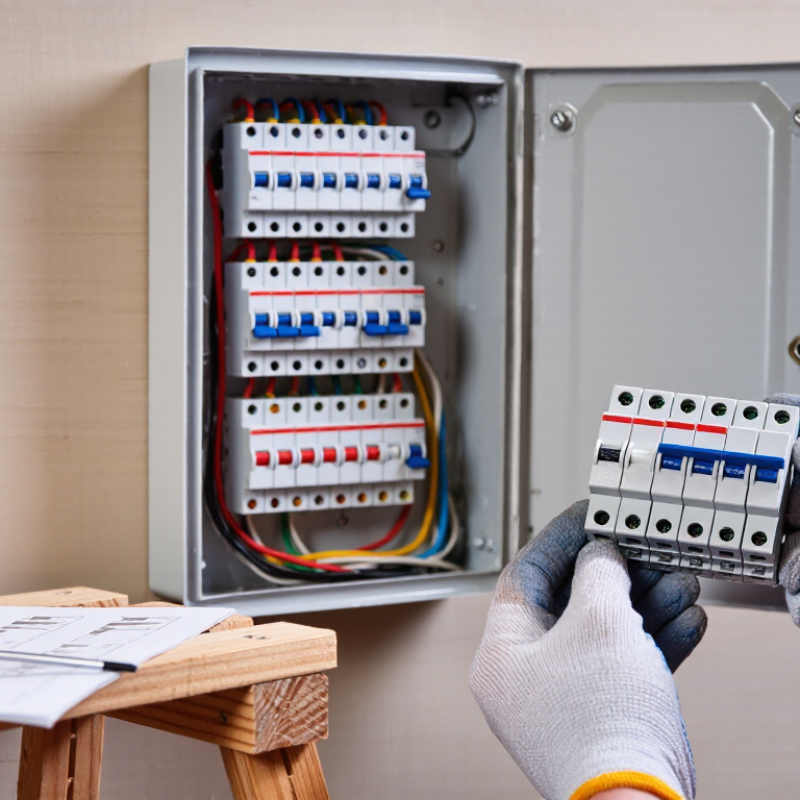
How to Choose the Right Main Circuit Breaker?
Determine the Electrical System’s Voltage and Phase
Before choosing a main circuit breaker, confirm your electrical system’s nominal voltage and phase. Check the service label, panel documentation, or utility records. A home may use single-phase power, while some commercial buildings use three-phase power. Do not guess from the number of wires; wiring arrangements vary. If the information is unclear, ask a licensed electrician to verify it.
Match the breaker’s voltage rating and pole configuration to the panel and supply. A three-phase system may require a different breaker arrangement than a single-phase system. Also distinguish line-to-line voltage from line-to-neutral voltage; confusing them can lead to a poor selection. The main breaker must also be listed for the specific panel, with suitable interrupting capacity. A correct voltage match alone is not enough.
Tips: Photograph the service label and note the stated voltage and phase before shopping. Compare those details with the panel’s specifications. Small labels can be hard to read, and assumptions are easy to make—even experienced people can miss a detail. Never open energized equipment to identify conductors. Have a qualified electrician confirm uncertain readings and assess the installation before replacing a main breaker.
Calculate the required amperage from the connected load, not from guesswork. List each appliance’s nameplate voltage and wattage, including heating equipment, pumps, and workshop tools.
For a single-phase supply, divide watts by volts. A 12,000-watt load at 240 volts draws 50 amps before any adjustments. For three-phase equipment, use amps = watts ÷ (1.732 × volts × power factor). Motors and other inductive loads may need extra attention because starting current can exceed running current.
Do not simply add every nameplate value and treat the total as the final answer. Apply the demand factors and continuous-load rules required for the installation. NFPA 70, the National Electrical Code, generally requires continuous loads to be calculated at 125% when sizing relevant circuit conductors and overcurrent protection. In the example, a 50-amp continuous load calculates to 62.5 amps. The appropriate breaker and service rating depend on the full load calculation, equipment ratings, and locally adopted code. Small details matter; I would recheck the appliance list before choosing a size.
Tips: Record each load’s voltage, wattage, and expected operating time. Check the panel and service ratings, too. If the calculation is uncertain, have a qualified electrician verify it.
How to Choose the Right Main Circuit Breaker?
Start by checking the panel label and documentation for its rated capacity and approved main-breaker types. The panel’s rating, service conductors, and calculated electrical load all matter. A larger breaker does not increase the capacity of the system. Nor does a breaker that physically fits necessarily suit the panel. Check the required amperage, number of poles, voltage, and interrupting rating. Panel interiors can look similar, but their approved breaker options may differ. That detail is easy to overlook.
Tips: Photograph the panel label and note its model and rating. Have a qualified electrician confirm compatibility before buying or replacing a main breaker. Never rely on appearance alone.
Also consider whether the panel has a main-breaker position or uses a different disconnect arrangement. Existing wiring, signs of heat, or unclear labels deserve professional review. A spacious-looking panel can still have strict limits. I would not guess from the old breaker’s handle rating alone; previous changes may not have been appropriate. Ask an electrician to verify the panel listing, conductor capacity, and load calculation together.
Pole count must match the system conductors the breaker needs to disconnect. A 120/240-volt split-phase panel commonly uses a two-pole main; a three-phase system typically calls for three poles. Check the equipment diagram and supply configuration, not just the panel label. A schedule that says “three-pole” but omits voltage leaves an important question unanswered. Neutral switching depends on the system design and applicable code, so do not assume pole count alone settles it.
Interrupting rating is different from ampere rating. It must meet or exceed the available short-circuit current at the breaker’s installation point, at the specified voltage. NEC 110.9 addresses this requirement, while UL 489 sets performance requirements for many molded-case breakers. A qualified professional can estimate fault current using utility data, transformer impedance, and conductor details. NFPA’s 2023 electrical-fire analysis estimated about 24,200 U.S. home structure fires annually from electrical failures or malfunctions during 2015–2019. That figure does not determine a breaker rating, but it underscores why assumptions deserve checking. I would verify the fault-current calculation against the actual equipment data; small details, such as an upstream transformer change, can alter the result.
| System or installation example | Typical pole-count consideration | Available fault current at the installation point | Minimum interrupting-rating consideration | Selection check |
|---|---|---|---|---|
| 120/240 V, single-phase, three-wire service | A 2-pole breaker is commonly used to disconnect both ungrounded conductors. Confirm the service and equipment configuration. | Example: 8 kA RMS symmetrical | Select a breaker rated to interrupt at least 8 kA at the applicable voltage. A 10 kA rating would exceed this example value. | Verify the breaker’s marked voltage rating and interrupting rating, and confirm that the available fault current is based on a suitable calculation or utility information. |
| 208Y/120 V, three-phase, four-wire system | A 3-pole breaker typically disconnects the three phase conductors. Switching the neutral depends on the system design, applicable code, and equipment requirements. | Example: 14 kA RMS symmetrical | Select a breaker rated to interrupt at least 14 kA at the applicable voltage. A 22 kA rating would exceed this example value. | Do not assume the neutral is a breaker pole. Follow the equipment instructions and applicable electrical rules for neutral switching. |
| 480Y/277 V, three-phase, four-wire system | A 3-pole breaker is commonly used for the three phase conductors. A switched neutral, if required, needs equipment specifically designed for that arrangement. | Example: 28 kA RMS symmetrical | Select a breaker rated to interrupt at least 28 kA at the applicable voltage. A 35 kA rating would exceed this example value. | Check the rating at 480 V; a breaker’s interrupting rating can vary with its applied voltage. |
| Three-phase system with a higher calculated fault current | Choose the pole count for the number of conductors that must be disconnected; pole count does not establish interrupting capacity. | Example: 42 kA RMS symmetrical | A breaker with a 35 kA rating would be insufficient for this example. Select a suitable rating of at least 42 kA, such as a 50 kA-rated device where available and approved for the application. | Confirm the exact rating at the system voltage and that the breaker is listed or approved for the intended equipment. |
| Panelboard using a documented series-rated combination | The main and downstream breaker pole counts must match their respective circuits and system configuration. | Example: downstream available fault current exceeds the downstream breaker’s individual interrupting rating | A series combination may be used only when the specific upstream and downstream devices are tested, listed, and marked for that combination and application. | Do not infer a series rating from the main breaker’s rating alone. Verify the equipment labeling, device combination, voltage, and installation conditions. |
Important: The fault-current values above are illustrative examples, not recommendations for a particular installation. The interrupting rating must be at least equal to the available fault current at the breaker’s installation point, at the applicable voltage. Pole count, neutral switching, breaker type, and ratings must be confirmed against the system design, equipment markings, manufacturer documentation, and applicable electrical codes.
How to Choose the Right Main Circuit Breaker?
Verify code compliance before selecting a breaker. The required rating depends on the service conductors, panelboard, calculated load, and available fault current—not simply the home’s square footage. Check the electrical code edition adopted by your local jurisdiction, including amendments, and confirm the panel’s listing and manufacturer-specified breaker compatibility. A breaker with the wrong interrupting rating may not safely clear the fault current available at that installation. Details matter.
The National Fire Protection Association’s Home Electrical Fires report estimated an annual average of 46,700 U.S. home fires involving electrical failure or malfunction from 2015 to 2019. These fires caused an estimated 390 civilian deaths and $1.5 billion in direct property damage. That figure does not mean an incorrect main breaker caused each fire, but it underscores why careful installation matters. Verify grounding and bonding, disconnect location, working clearances, and conductor terminations against applicable requirements. A crowded panel or a service upgrade can change what is needed. One detail is easy to overlook: the authority having jurisdiction may require permits and inspection. Have a qualified electrician confirm the load calculation, fault-current rating, and local requirements before installation; assumptions based on an old panel can be wrong.
Verify code compliance and installation requirements before selecting a rating.
The chart shows standard ampere ratings listed in NEC 240.6(A); it does not indicate which rating is suitable for a particular installation. Base selection on the calculated load, service and conductor ratings, panel compatibility, and the locally adopted electrical code. Consult a qualified electrician or electrical inspector.
Check the service label, panel documents, or utility records. Do not guess from wire count. If details are unclear, ask a qualified electrician to verify them.
It must match the panel and electrical supply. Single-phase and three-phase systems may need different arrangements. Line-to-line and line-to-neutral voltage are not interchangeable.
No. The panel rating, service conductors, and calculated load also matter. A larger breaker does not increase system capacity. I might still miss a faded label, so a second check matters.
Read the panel label and documentation for approved breaker types, amperage, poles, voltage, and interrupting rating. Physical fit alone proves little. Looks can mislead.
It is the breaker’s ability to interrupt available fault current safely. The rating must suit the installation, not just the voltage.
Requirements depend on local rules, service conductors, panel listing, load calculations, and available fault current. Grounding, bonding, clearances, and conductor connections matter too.
No. Never open energized equipment for identification. Have a qualified electrician check uncertain readings and assess the installation.
Local authorities may require both, especially for service changes. Ask an electrician to confirm local requirements before work begins. A spacious panel can still have limits.
Choosing the right Main Circuit Breaker starts with identifying the electrical system’s voltage and whether it is single-phase or three-phase. Next, estimate the total amperage required by the connected loads, allowing for expected usage and any planned additions. These details help determine a breaker that suits the system without exceeding the electrical panel’s rated capacity.
Before selecting a breaker, confirm which types the panel can accommodate. Choose the appropriate number of poles for the system, and check that the interrupting rating is suitable for the available fault current. Finally, verify that the breaker and its installation meet applicable electrical codes and the panel’s requirements. Careful checks at each step help ensure the breaker is compatible with the system and provides appropriate protection.

AceReare